
Quick answer
Set aside 25-30% of every 1099 payment for taxes. For most contractors that covers the 15.3% self-employment tax, federal income tax and a typical state income tax, with a small cushion.
Adjust it to your situation:
- Profit under ~$40,000 and no state income tax: 20% is usually enough.
- Profit of $40,000-$100,000: 25-30% depending on your state.
- Profit above $100,000, or a high-tax state like California or New York: 30-35%.
- You have a W-2 job too: your side income is taxed at your highest bracket, so lean toward 30%.
The percentage applies to what clients pay you. Because you only owe tax on profit (income minus business expenses), setting aside a share of gross payments builds in extra safety.
Why 1099 contractors need to set money aside
When you’re a W-2 employee, your employer withholds taxes from every paycheck. As a 1099 contractor, clients pay you the full amount and nobody withholds anything. The whole tax bill is yours to pay, and the IRS expects it during the year through quarterly estimated payments, not all at once in April.
The most common first-year mistake is spending that money and facing a five-figure bill, plus an underpayment penalty, at tax time.
What your tax bill is made of
Your 1099 income is hit by up to three layers of tax:
| Tax | Rate in 2026 | What it applies to |
|---|---|---|
| Self-employment tax | 15.3% (12.4% Social Security + 2.9% Medicare) | 92.35% of your net profit; the Social Security part stops at $184,500 |
| Federal income tax | 10% to 37%, by bracket | Your taxable income after deductions |
| State and local income tax | 0% to over 10%, depending on where you live | Varies by state and city |
Three deductions soften the federal part:
- Half of your self-employment tax is deducted from your income.
- The standard deduction: $16,100 for single filers in 2026.
- The qualified business income (QBI) deduction: up to 20% of your business income for most contractors.
That’s why your real, effective rate is much lower than «15.3% + your tax bracket».
How much federal tax you’ll really pay in 2026
We calculated the 2026 federal tax bill for a single contractor with no other income, taking the standard deduction and the QBI deduction. Self-employment tax stays at about 14% of profit at every level; income tax is what grows as you earn more.
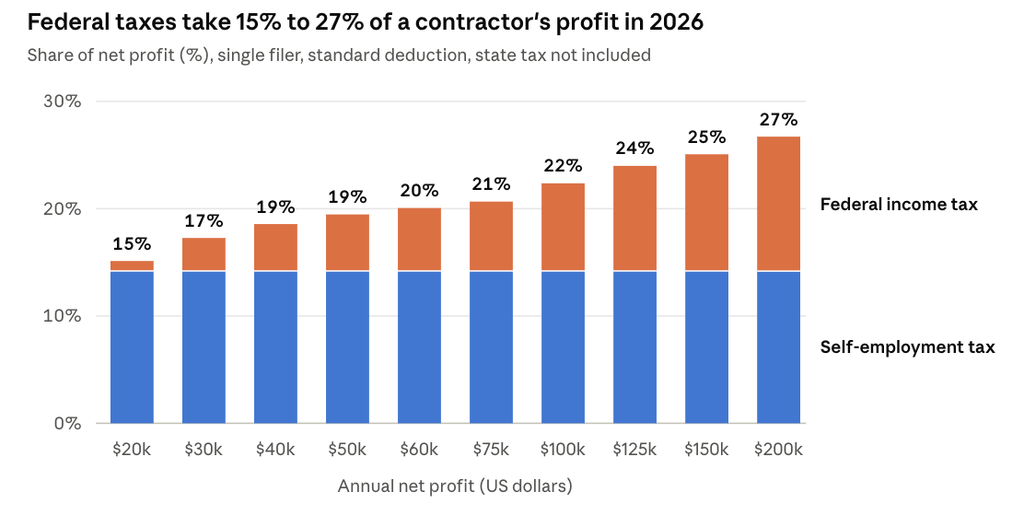
For example, a contractor with $60,000 of profit owes about $12,037 in federal tax (20%), and one with $100,000 owes about $22,365 (22%).
Add your state income tax
The chart covers federal taxes only. Add your state’s rate on top:
| Your state | What to add | Examples |
|---|---|---|
| No state income tax | 0% | Alaska, Florida, Nevada, South Dakota, Tennessee, Texas, Washington, Wyoming |
| Low or flat income tax | About 3-5% | Many states with flat taxes |
| High income tax | About 6-10% or more at higher incomes | California, New York, New Jersey, Oregon |
Some cities (such as New York City) add their own income tax, and New Hampshire does not tax wages or business income. Check your state’s revenue department for exact rates.
How to calculate your own percentage
The 25-30% rule is a safe default. To find your real number, follow these five steps once you have a few months of income:
- Estimate your yearly revenue from what you’ve invoiced so far.
- Subtract your business expenses (software, equipment, home office, mileage) to get your net profit.
- Calculate self-employment tax: profit × 92.35% × 15.3%.
- Estimate federal income tax: subtract half of your SE tax, the standard deduction and the QBI deduction, then apply the tax brackets. A self-employment tax calculator does this in seconds.
- Add state tax, then divide the total by your revenue. That’s the share of each payment to set aside.
Example: a freelance designer
Single filer, state income tax of about 5%, no other income:
| Line | Amount |
|---|---|
| Revenue from clients | $80,000 |
| Business expenses | −$12,000 |
| Net profit | $68,000 |
| Self-employment tax | $9,608 |
| Federal income tax (after half of SE tax, $16,100 standard deduction and $9,419 QBI deduction) | $4,273 |
| State income tax (approx. 5%) | $3,160 |
| Total tax for the year | $17,041 |
| Share of revenue to set aside | 21.3% |
| Quarterly estimated payment | about $4,260 |
Our designer would be safe setting aside 22-25% of every invoice. If they used the generic 30% rule, they’d end the year with about $7,000 of extra savings, which isn’t a bad problem to have.
Where to keep your tax money
- Open a separate high-yield savings account just for taxes. Keeping it out of your checking account removes the temptation to spend it, and the interest is a small bonus. See our best high-yield savings accounts for tax money.
- Transfer your percentage the day each payment arrives. Many banks let you automate this with rules or «buckets».
- Don’t invest it in stocks or crypto. You’ll need it within three months; it should be safe and available.
When to pay: quarterly estimated taxes
If you expect to owe $1,000 or more for the year, the IRS wants you to pay in four installments with Form 1040-ES:
| Income earned in 2026 | Payment due |
|---|---|
| January 1 – March 31 | April 15, 2026 |
| April 1 – May 31 | June 15, 2026 |
| June 1 – August 31 | September 15, 2026 |
| September 1 – December 31 | January 15, 2027 |
Pay online through IRS Direct Pay or your IRS online account. Your state probably has its own estimated payments too.
Avoid penalties with the safe harbor rule: you won’t pay an underpayment penalty if you pay at least 90% of this year’s tax or 100% of last year’s total tax (110% if last year’s AGI was above $150,000). In your first year, if you owed nothing the previous year, you’re generally protected from the penalty, but you still owe the full tax in April. Read more in Quarterly Estimated Taxes: Due Dates and How to Calculate Them.
Common mistakes to avoid
- Only saving for income tax. The 15.3% self-employment tax is often the bigger part of the bill for new contractors.
- Waiting until April. Skipping quarterly payments can trigger penalties and a painful lump sum.
- Forgetting state tax. It can add 5-10% in some states.
- Not tracking expenses. Every deductible expense lowers your bill. Check our complete list of self-employed tax deductions.
- Never adjusting the percentage. Review it every quarter as your income changes.
Frequently asked questions
Is 30% too much to set aside for 1099 taxes?
For many contractors earning under $75,000 in a low-tax state, yes, 30% is more than they’ll owe. That’s not a bad thing: the surplus becomes savings once you file. If you’d rather keep more cash flow, calculate your real rate with the steps above.
Do I pay tax on the full 1099 amount?
No. You pay tax on your net profit, which is your 1099 income (and any other business income) minus deductible business expenses.
How much tax do I pay on $50,000 of 1099 income?
If $50,000 is your net profit, you’ll owe about $9,700 in federal tax in 2026 as a single filer (about 19.5%), plus any state income tax.
What if I also have a W-2 job?
Your salary already uses up the standard deduction and the lower tax brackets, so your 1099 profit is taxed at your top rate plus 15.3% self-employment tax. Set aside 30% or more, or raise the withholding on your W-4 at work to cover it.
Do I need to set aside money if I didn’t receive a 1099?
Yes. All self-employment income is taxable, with or without a form. From 2026, clients only send a 1099-NEC when they pay you more than $2,000 in the year.
What happens if I don’t set aside enough?
You’ll owe the difference when you file, plus an underpayment penalty if you missed the safe harbor. If you can’t pay in full, the IRS offers payment plans, but interest and penalties keep adding up.
This article is general information, not tax advice. Your situation may differ; consult a CPA or Enrolled Agent.